What Happens During a Brain Map (QEEG)?
What Happens During a Brain Map (QEEG)?
Booking your first brain map can feel like stepping into the unknown. What does the process involve? Will it be uncomfortable? What will the results tell you? This guide walks you through every step so you know exactly what to expect.
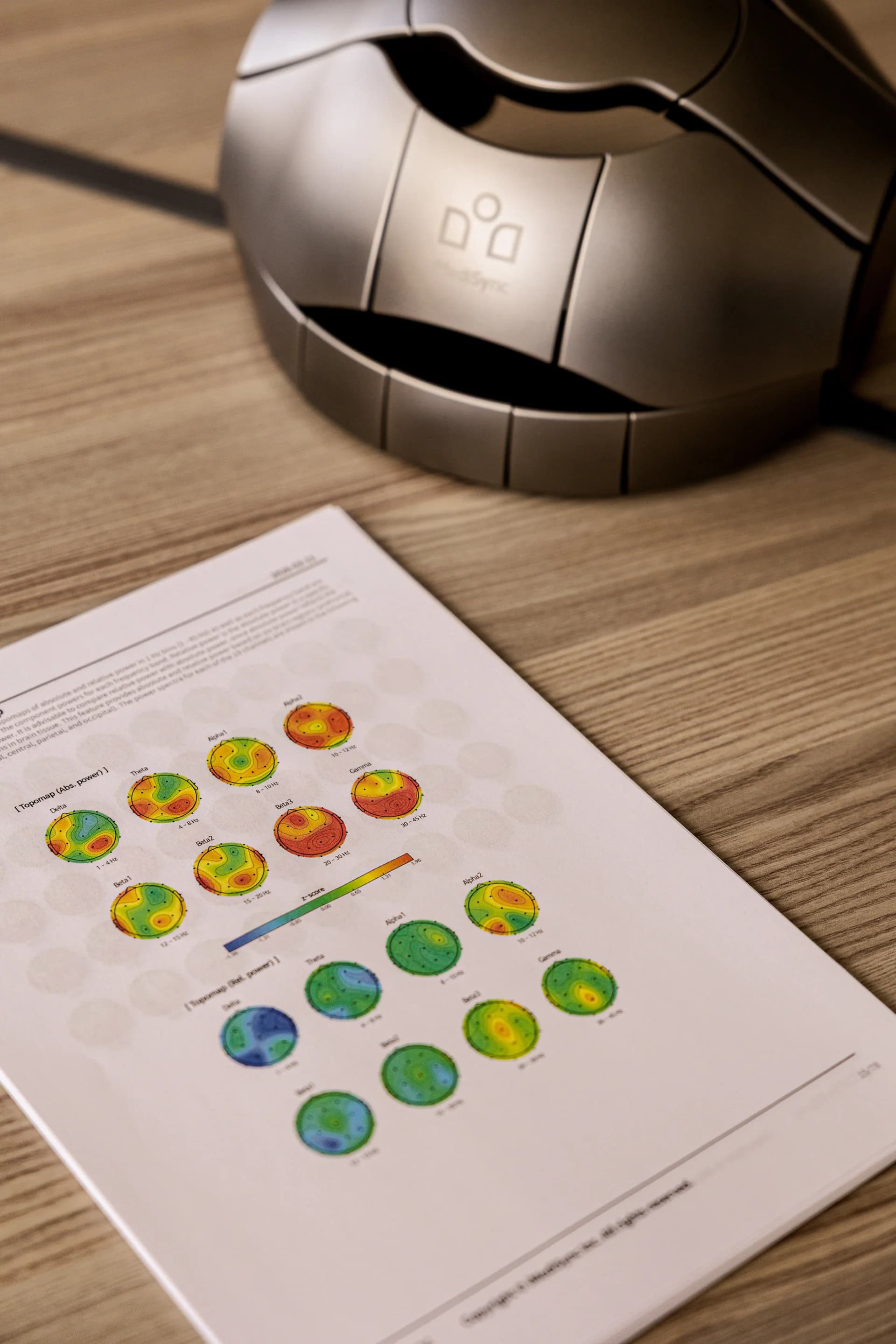
A brain map, formally known as a quantitative electroencephalogram (QEEG), is a non-invasive assessment that records and analyses your brain's electrical activity. It provides a detailed, colour-coded map showing how different regions function, how they communicate, and where patterns may relate to the symptoms you are experiencing.
Why Get a Brain Map?
Your brain is unique. Just as a blood test gives your doctor objective data about your physical health, a brain map provides objective data about your brain's electrical functioning. Rather than relying solely on questionnaires, a QEEG reveals what is actually happening beneath the surface.
Two people with identical symptoms may have very different brainwave patterns driving those symptoms. A brain map ensures that any neurofeedback training we recommend is precisely targeted to your individual brain, not a generic protocol.
A brain map does not diagnose medical conditions. It identifies patterns of brainwave activity that research has associated with specific symptoms and difficulties, helping us design the most effective training programme for you.
Before Your Appointment
Preparing for a brain map is straightforward. We will send you detailed instructions when you book, but here are the key points:
- Clean, dry hair: Please wash your hair on the day of your appointment and avoid using conditioner, hair oil, gel, or styling products. These can interfere with the sensors' ability to pick up electrical signals.
- Medication: Continue taking any prescribed medication as normal unless your clinician advises otherwise. We will ask about your medications, as some can influence brainwave patterns.
- Caffeine and sugar: Avoid excessive caffeine or sugar in the hours beforehand, as these can temporarily alter brainwave activity.
- Arrive rested: A good night's sleep helps ensure the recording reflects your typical brain activity.
- Allow enough time: The full appointment usually takes around 75 to 90 minutes. There is no need to rush.
If you are bringing a child for an assessment, it can help to explain that they will be wearing a special cap that reads their brain, a bit like a superhero helmet. Many children find the process genuinely interesting once they understand there is nothing to be nervous about.
The Recording Process
When you arrive at the clinic, your practitioner will welcome you and spend a few minutes discussing your history, current symptoms, and goals. This conversation helps us interpret the brain map data in the context of your lived experience.
Then comes the recording itself:
- Fitting the cap: We use an EEG cap with 19 sensors positioned according to the international 10-20 system. A small amount of conductive gel is applied to each site to ensure a clear signal. The cap fits snugly but comfortably.
- Eyes-closed recording: You sit quietly with your eyes closed for approximately five minutes while we record your brain's resting-state activity.
- Eyes-open recording: Next, you sit with your eyes open, looking at a fixed point, for another five minutes. This shows how your brain responds when visual input is present.
- Additional tasks (if applicable): Depending on your concerns, we may record while you perform a short reading or listening task to see how your brain responds under cognitive demand.
The entire recording process typically takes 20 to 30 minutes. It is completely painless. The sensors only read electrical activity; they do not send any signals into your brain. Most people describe the experience as surprisingly relaxing.
What We Measure
Using sophisticated analysis software, we examine several key dimensions of your brain's electrical activity:
- Absolute and relative power: How much activity is present in each frequency band (delta, theta, alpha, beta, gamma) at each sensor site. This tells us whether specific areas are overactive or underactive.
- Coherence: How well different regions of the brain communicate with each other. Poor coherence can be associated with difficulties in processing speed, coordination of thought, or emotional regulation.
- Asymmetry: Whether corresponding regions on the left and right sides of the brain are balanced. Certain asymmetry patterns have been linked in research to mood difficulties and emotional processing.
- Peak frequency: The dominant speed of activity in key regions, which can relate to processing speed, arousal levels, and cognitive efficiency.
Your data is compared against a normative database of age-matched, healthy individuals. This allows us to identify where your brain's patterns differ significantly from what is typically expected, providing objective markers to guide your training.
To learn more about the technology behind this process, visit our technology page.
Analysis and Reporting
After your recording, the analysis phase begins. This is where the raw data is transformed into a meaningful clinical picture. Your practitioner will:
- Clean the data: Remove artefacts caused by eye blinks, muscle tension, or movement to ensure the analysis reflects genuine brain activity.
- Run the quantitative analysis: Process the cleaned data through our software, generating topographic brain maps and statistical comparisons against the normative database.
- Interpret the findings: The numbers and maps must be interpreted in the context of your symptoms, history, and goals. A statistically unusual pattern may or may not be clinically significant. Your practitioner's expertise is essential here.
- Prepare your report: We compile findings into a clear report with brain maps, explanations, and training recommendations.
The analysis typically takes three to five working days. We take this time because thorough, careful interpretation is essential to designing an effective programme.
Your Review Session
Once your report is ready, we will invite you back for a review session. This is a collaborative conversation, not a lecture. Your practitioner will:
- Walk you through your brain maps, explaining what the colours and patterns mean in plain language
- Connect the findings to the symptoms and difficulties you described
- Explain which brainwave patterns we recommend targeting and why
- Outline a proposed neurofeedback training programme, including the number of sessions, frequency, and what you might expect to experience
- Answer any questions you have
You are welcome to bring a partner, parent, or friend to the review session. We want you to feel fully informed before making any decisions about proceeding with training.
Many clients tell us that simply seeing their brain map was a turning point. Understanding that their difficulties have a measurable, physiological basis, rather than being "all in their head" in the dismissive sense, can be profoundly validating.
Key Takeaways
- A brain map (QEEG) is a painless, non-invasive recording of your brain's electrical activity.
- The recording takes about 20 to 30 minutes, with the full appointment lasting around 75 to 90 minutes.
- Your data is compared against a normative database to identify patterns that may relate to your symptoms.
- The analysis takes three to five working days, ensuring thorough interpretation.
- A review session walks you through your results and outlines a personalised training plan.
- No preparation is needed beyond clean hair and a reasonable night's sleep.
Book Your Brain Map
A brain map is the foundation of effective neurofeedback at Inna MediSync. It takes the guesswork out of the process and gives both you and your practitioner a clear, objective starting point. Our private clinic in Romford, Essex serves clients from across East London and the surrounding area. Contact us to book your QEEG assessment or to ask any questions about the process. No referral is needed.
Inna MediSync Clinical Team
Neurotherapy Specialists
The Inna MediSync clinical team brings together certified neurotherapy practitioners with expertise in QEEG brain mapping and neurofeedback. Every article is reviewed for clinical accuracy and reflects our commitment to evidence-informed practice.
Continue Reading

Ready to Explore Neurotherapy?
Take the first step towards understanding your brain. Book a free consultation with our clinical team.